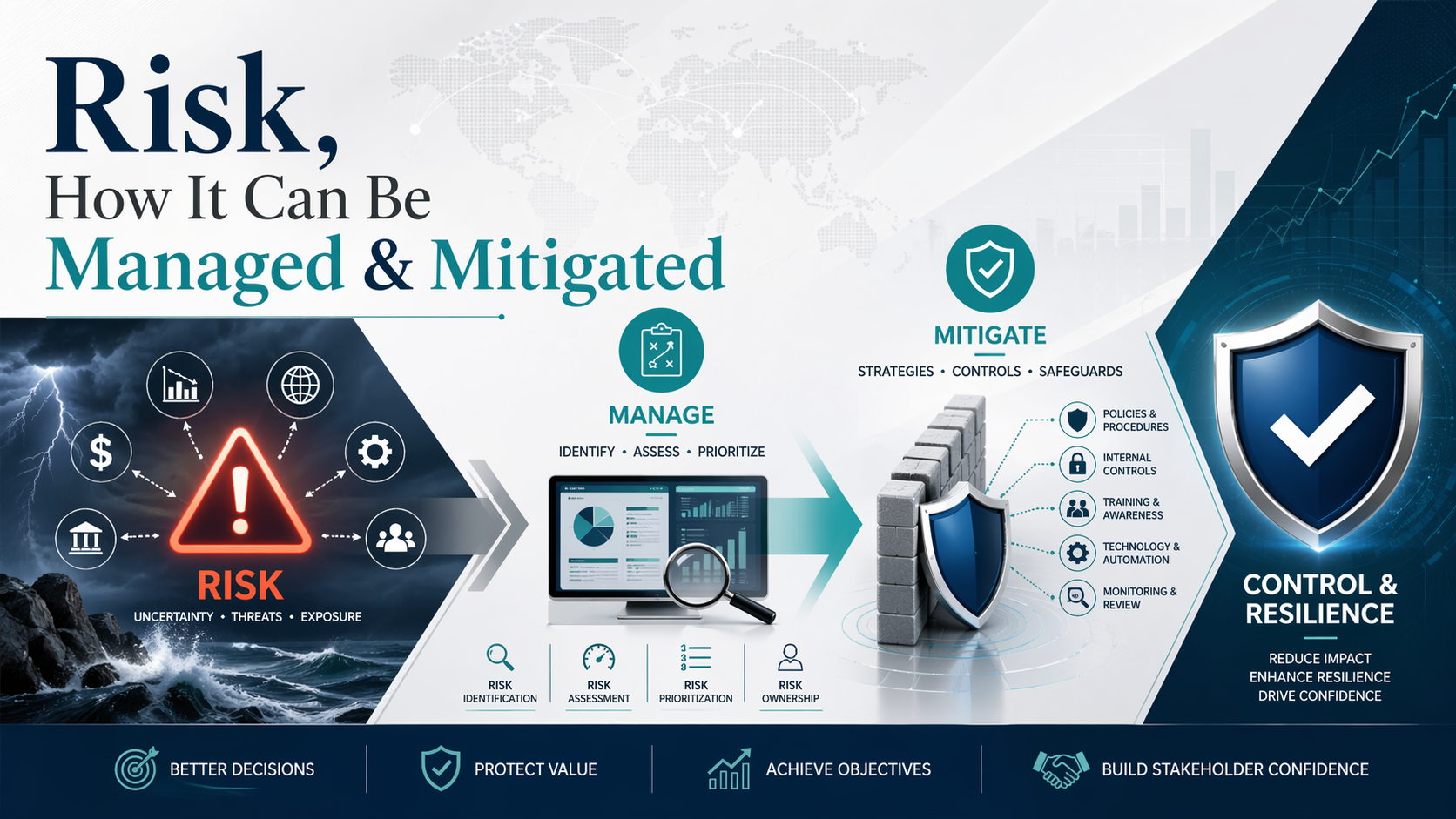
Introduction: Why Risk Management Matters
Risk is an inherent feature of every strategic decision, from capital allocation to operational change. For C-suite executives, board members, family business owners and institutional investors in the GCC, robust risk management is not a compliance exercise but a value-preserving discipline that supports Vision 2030 ambitions, long-term investment returns and sovereign wealth fund mandates.
Understanding Risk: Types and Drivers
Risk arises from volatility in markets, regulatory shifts, operational failures, cyber threats, geopolitical tensions and climate change. Categorizing risk helps prioritize response:
Strategic risk: business model disruption, market entry failures.
Market and investment risk: asset price volatility and liquidity risk.
Operational risk: process failures, human error, supplier disruption.
Compliance and legal risk: regulatory non-compliance and litigation.
Reputational risk: stakeholder trust erosion and brand damage.
Emerging risks: cyber, ESG, climate transition and technological change.
Establishing an Enterprise Risk Framework
An effective enterprise risk framework (ERF) aligns risk appetite with strategy and embeds consistent practices across the organisation. Key components of an ERF include:
Risk appetite statement: defines acceptable risk levels for boards and management.
Risk taxonomy: a common language for categorizing and reporting risks.
Risk assessment methodologies: qualitative and quantitative scoring, scenario analysis, and stress testing.
Control and mitigation playbooks: standardized responses for priority risks.
Reporting and escalation protocols: clear pathways from operational units to the board risk committee.
Integrating ERF with Strategy and Investment Planning
Linking the ERF to strategic planning ensures that risk considerations inform capital allocation, M&A, new market entry and portfolio construction. For sovereign wealth funds and family offices, integrating ERF into investment strategy enhances resilience and return stability.
Governance and the Board's Role
Boards set tone and oversight for risk culture. Effective governance practices include:
Defining risk appetite and approving the ERF.
Maintaining an independent risk committee with appropriate expertise.
Ensuring management implements risk policies and reports material exposures promptly.
Regularly reviewing major risk metrics and stress test outcomes.
Fostering a culture where risk escalation is encouraged and rewarded.
Risk Mitigation Techniques
Mitigation is not one-size-fits-all. Practical techniques align with the organization's risk appetite and resource constraints:
Avoidance: Cease activities that do not fit strategic risk appetite.
Reduction: Strengthen controls, diversify portfolios, and improve processes to lower risk likelihood or impact.
Transfer: Use insurance, hedging or contractual risk transfer to shift exposure.
Acceptance: Intentionally retain low-likelihood or low-impact risks while monitoring indicators.
Operational Controls and Technology
Operational risk reduction relies on robust policies, automation, segregation of duties and resilient supply chains. Cybersecurity and data governance are critical priorities; investments in threat detection, incident response and encryption reduce systemic operational losses and reputational harm.
Monitoring, Reporting and Culture
Continuous monitoring combined with clear reporting ensures early detection and timely action. Key practices include:
Key risk indicators (KRIs) linked to early-warning thresholds.
Integrated risk dashboards for management and board-level reporting.
Regular internal and external audits to validate control effectiveness.
Training programs to embed risk awareness across the organisation.
Scenario Analysis and Stress Testing
Scenario planning and stress testing quantify potential losses under adverse conditions. For institutional investors and sovereign wealth funds, stress tests should include market shocks, prolonged commodity price shifts and geopolitical scenarios relevant to the GCC. Results guide capital buffers, liquidity strategy and asset allocation adjustments.
GCC Considerations: Vision 2030 and Regional Dynamics
GCC economies are undergoing structural transformation under Vision 2030 initiatives. This creates opportunities and unique risks: accelerated public-private partnerships, rapid privatization, and diversification away from hydrocarbons. Effective risk management balances ambitious growth targets with disciplined governance, ESG integration and strategic diversification to protect long-term wealth and public value.
Tailoring Risk Approaches for Family Offices and Sovereign Funds
Family offices prioritize wealth preservation, intergenerational governance and bespoke asset allocation. A conservative risk posture, combined with active governance and succession planning, is critical. Sovereign wealth funds focus on capital preservation, long-term returns and national strategic objectives; they need sophisticated ERFs, liquidity management and clear alignment between political mandates and investment risk tolerance.
Conclusion: Operationalise Risk into Strategic Advantage
Risk is manageable when treated as a strategic input rather than a constraint. Boards, executives and investors who adopt a structured enterprise risk framework, strengthen governance, deploy targeted mitigation techniques and embed a risk-aware culture create durable competitive advantage. In the GCC, aligning these practices with Vision 2030 and regional market dynamics positions organisations and funds to capture opportunities while safeguarding capital.
For board advisory, enterprise risk assessments or tailored risk frameworks for family offices and sovereign funds, engage with experienced governance and investment advisors to transform risk into resilient value creation.