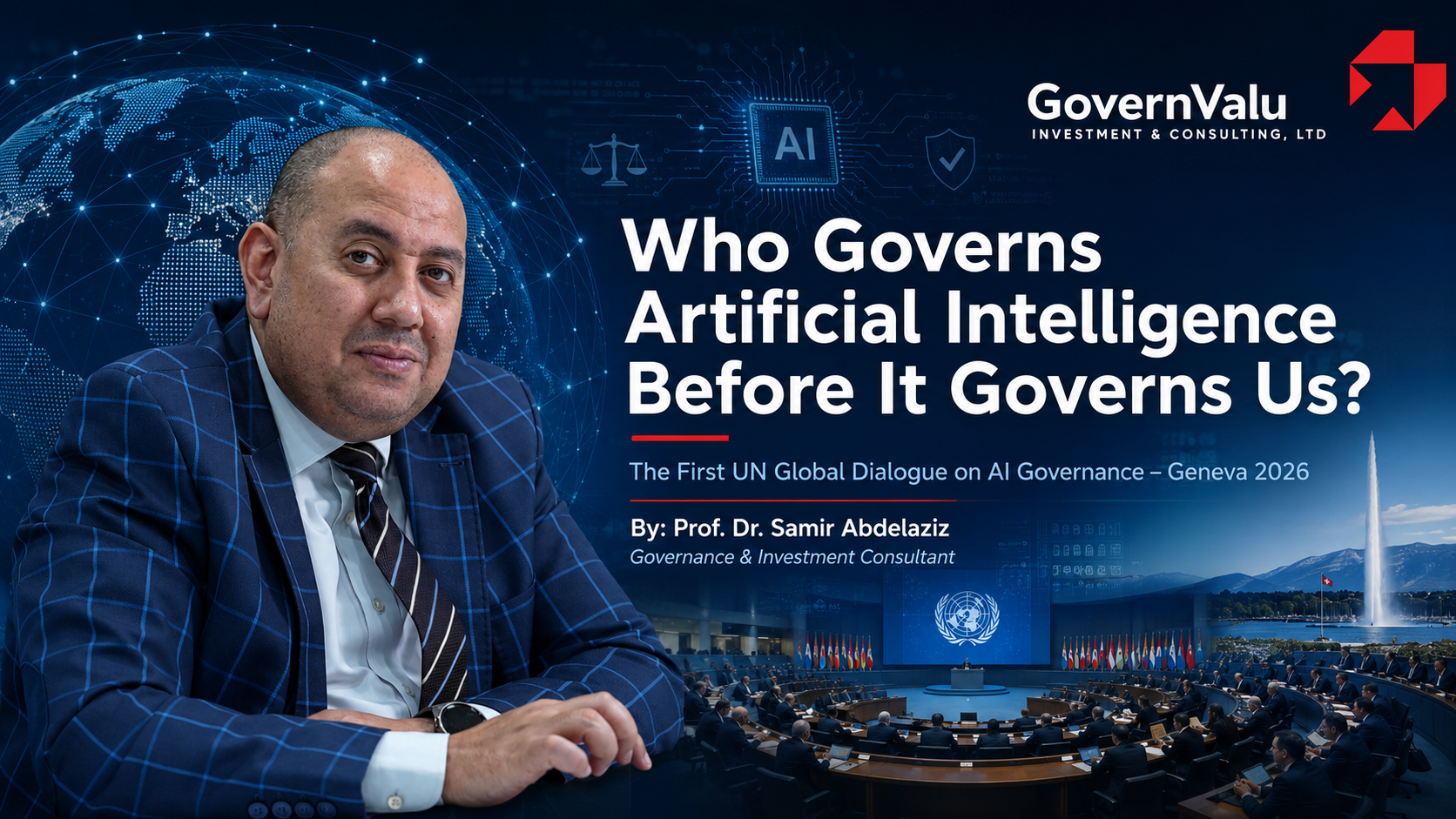
Written By: Prof. Dr. Samir Abdelaziz
Geneva Opens One of the Most Difficult Governance Debates of the Digital Century
The question is no longer whether artificial intelligence will change our world. It is already transforming the economy, education, healthcare, public administration, the media, labour markets, and even the way we make everyday decisions.
The more consequential question is now this: Who will establish the rules governing this transformation? Who will be held accountable when an algorithm makes an error, misleads users, discriminates against individuals, or causes harm?
This is precisely why the First United Nations Global Dialogue on Artificial Intelligence Governance carries exceptional significance. Its inaugural session was held in Geneva on 6 and 7 July 2026, bringing together governments, technology companies, the scientific community, and civil society. The next session is scheduled to take place in New York in May 2027.
The Dialogue was established by a United Nations General Assembly resolution, building on the commitments set out in the Global Digital Compact, and is intended to serve as an inclusive international platform for discussing cooperation, governance frameworks, and the exchange of expertise in the field of artificial intelligence.
This event should not be viewed merely as another technology conference or a further round of general ethical discussions. What matters most about Geneva is that the international community has begun—albeit gradually—to move from debating the ethics of artificial intelligence to developing a system of effective AI governance.
From Ethical Principles to Institutional Accountability
Ethics tells us what ought to be done. Governance determines who decides, who supervises, who is accountable, how misconduct or failure is detected, and what action must be taken when harm occurs.
For this reason, AI governance extends far beyond passing a law or publishing an ethical charter. It is a comprehensive system that includes the allocation of responsibilities, risk classification, human oversight, pre-deployment testing, data-quality reviews, model transparency, privacy protection, independent auditing, and clear mechanisms for appeal, redress, and compensation.
From a corporate governance perspective, technology companies should not simultaneously act as the designers, developers, operators, evaluators, and final judges of their own systems.
An organisation that generates revenue from deploying an AI system cannot be the sole authority determining whether that system is safe or fair. Just as the assessment of financial statements cannot be left entirely to executive management, the evaluation of high-risk algorithms should not be entrusted exclusively to those who developed and commercialised them.
The essence of governance, therefore, lies in separating the development of technology from its approval, oversight, and the investigation of its potential harms.
The First Scientific Assessment: Ignorance Is No Longer an Excuse
The Geneva Dialogue coincided with the presentation of the first report by the Independent International Scientific Panel on Artificial Intelligence, comprising forty experts from different regions of the world.
The report represents the first independent global scientific assessment of the opportunities, risks, and impacts associated with artificial intelligence. It addressed seven principal areas, including scientific developments, economic effects, healthcare, education, agriculture, security, the environment, human rights, democracy, child safety, and the tools required for governance and regulatory management.
The importance of this assessment lies in its ability to move the debate away from speculation, impressions, and commercial interests towards a shared scientific evidence base on which policymakers can rely.
The report concluded that the use of artificial intelligence is expanding rapidly, but not equitably. It also highlighted the extreme concentration of advanced model development and computing capacity.
According to the data presented in the assessment, the United States accounts for approximately 75 per cent of the computing capacity used by the world’s five hundred leading AI-related supercomputers, compared with around 15 per cent for China. Meanwhile, most developing countries continue to lag behind in infrastructure, data availability, technical expertise, and the ability to develop their own models.
This concentration is not merely a technical issue. It is a matter of governance, sovereignty, and economic justice.
Those who control data, computing capacity, and foundation models possess an increasing ability to influence knowledge, markets, employment, public services, and national security.
For this reason, United Nations Secretary-General António Guterres issued a clear warning: the more artificial intelligence advances without common rules, the less capable governments and societies become of directing its consequences.
He explicitly urged governments not to wait, stressing that the scientific evidence is now available and that the world can no longer claim that it was unaware of the scale of the opportunities or the risks.
Innovation Requires Guardrails
Guterres called for harmonised international rules to regulate artificial intelligence, arguing that innovation requires safeguards and that the more powerful the technology becomes, the greater the need for effective governance.
This call is particularly important because of the speed at which the technology is spreading.
The Secretary-General noted that the internet took approximately fifteen years to reach one billion users, while artificial intelligence reached that scale in roughly two years. He also warned that a technology capable of reshaping economies, influencing elections, transforming labour markets, and altering security balances is being deployed faster than institutions and regulators—and, in some cases, even its own developers—can fully understand its consequences.
However, regulation should not become a bureaucratic instrument that suppresses innovation. Nor should the language of innovation be used as a pretext for releasing untested systems into society.
Good governance does not place unnecessary brakes on technology. It creates a safer path for its use.
It does not seek to eliminate all risk. Rather, it distinguishes between acceptable risks, risks requiring additional safeguards, and applications that should be prohibited because they threaten fundamental rights, human life, or human dignity.
The required international framework should therefore establish a minimum set of common rules covering system safety, decision transparency, data protection, human oversight, incident reporting, and accountability for harm, while allowing countries to adapt these principles to their legal, cultural, and developmental contexts.
Children Must Not Become a Digital Testing Ground
Child safety occupied a central place in the Secretary-General’s remarks. He called for an international commitment to protect children from the risks of artificial intelligence and insisted that companies should be required to demonstrate the safety of their systems before making them available to minors.
Children today do not necessarily interact with artificial intelligence merely as a search engine. They may treat it as a teacher, a companion, a psychological adviser, or a source of guidance and information.
The risks become significantly greater when a system provides misleading answers, encourages harmful behaviour, exploits emotional vulnerability, or generates abusive and inappropriate content.
Guterres called for preventing AI systems from producing sexualised images of children and for requiring systems to stop automated interaction and refer a child to qualified human assistance when signs of distress, danger, or psychological vulnerability are detected.
This issue exposes a broader flaw in the prevailing technology-development model: products are often released first, while their social and psychological consequences are studied only after harm has occurred.
Sound governance requires the opposite approach: safety must become a precondition for deployment, not a reaction after damage has already been done.
The Risk of a New Global Divide
One of the most important messages emerging from Geneva is that artificial intelligence may become a powerful force for development, but it will not produce fairness automatically.
The technology reaches first those countries and institutions that possess data centres, energy capacity, high-speed connectivity, advanced universities, technical expertise, capital, and well-structured data.
Countries lacking these capabilities may find themselves dependent on models designed outside their own environments and trained on data that does not adequately reflect their languages, cultures, or priorities.
The United Nations has warned that the existing digital divide could harden into an artificial intelligence divide, which could then evolve into a broader developmental, security, and sovereignty divide.
In this context, Guterres announced his intention to submit recommendations to the General Assembly concerning the creation of a Global Fund for Artificial Intelligence, intended to support skills development, data infrastructure, and affordable computing capacity in countries with more limited resources.
Funding alone, however, will not be sufficient.
Closing the gap requires the development of national institutions capable of understanding technology, evaluating it, and negotiating its terms of use—not merely purchasing ready-made applications.
Can the United Nations Turn Dialogue into Rules?
Despite its historical significance, the first session of the Dialogue was not designed to produce a legally binding international treaty. Its purpose was to bring positions closer together and to discuss principles, risks, opportunities, and governance approaches.
This is where the real challenge lies.
Over recent years, the world has produced dozens of ethical principles, charters, and recommendations. Yet many remain fragmented, inconsistent, and largely voluntary, with little clarity regarding their effectiveness in practice.
The United Nations scientific assessment itself pointed to the proliferation and fragmentation of governance tools, many of which remain concentrated within a limited number of companies and countries.
The success of the Geneva Dialogue will therefore not be measured by the quality of its speeches or the number of participants. It will be measured by its ability to generate practical outcomes.
Such outcomes could include common international standards for testing advanced AI systems, a global registry of serious AI incidents, disclosure requirements concerning model capabilities and risks, independent review mechanisms, protection for whistleblowers within technology companies, and genuine human oversight of decisions affecting rights, freedoms, and human life.
AI governance must also not remain an issue negotiated exclusively by major powers and large technology corporations.
Developing countries are among those most exposed to the consequences of systems they did not help design, while often possessing the least capacity to detect bias, manipulation, or excessive technological dependence.
What Does This Mean for Arab and Gulf States?
The Gulf states have an exceptional opportunity to move from being consumers of technology to becoming active participants in shaping its rules.
Large-scale investment in digital transformation, data centres, cloud computing, and smart cities can provide the region with meaningful influence—provided that technological investment is accompanied by the development of mature governance systems.
Arab governments and institutions need clear national frameworks for AI governance, specialised committees at cabinet and board levels, comprehensive inventories of AI systems in use, mandatory risk and impact assessments, accountability and audit policies, and stricter rules for the use of artificial intelligence in sensitive sectors such as healthcare, education, finance, recruitment, justice, and public services.
The region also needs greater Gulf and Arab cooperation in the areas of model safety, data protection, regulatory testing, Arabic-language capabilities, local datasets, cybersecurity, and government procurement.
Purchasing an intelligent system without understanding the sources of its data, the limits of its accuracy, and the mechanisms available for challenging its decisions does not constitute digital transformation. It may instead amount to importing invisible risks.
Most importantly, AI governance must become part of organisational strategy rather than remaining a technical matter confined to information technology departments.
Boards of directors and executive management are responsible for understanding where algorithms are being used, which decisions are delegated to them, and what legal, operational, ethical, and reputational risks arise from their deployment.
Governing Technology Begins with Governing Human Decisions
The greatest challenge presented by artificial intelligence is not that machines may become more intelligent. It is whether human institutions will remain capable of exercising wisdom, responsibility, and accountability.
We do not need to choose between progress and protection, or between innovation and rights.
We need a model in which protection becomes part of innovation, transparency becomes a source of trust, and accountability becomes a condition for sustainability.
Geneva has opened the door to the development of global governance for artificial intelligence, but the road ahead remains long.
Algorithms evolve in weeks, while laws and institutions often require years.
Unless the world acts with both urgency and responsibility, we may discover that the rules have already been written—not by parliaments or international institutions, but within software code and business models controlled by a small number of companies.
The question that should concern governments, boards of directors, and societies is therefore not only:
What can artificial intelligence do?
It must also be:
Who authorized it to do so, under what safeguards, for whose benefit, and who will be held accountable when it fails?
These are the real questions of governance.
They will determine whether artificial intelligence remains a tool in the service of humanity—or whether humanity gradually becomes subject to decisions it neither understands nor has the power to challenge.